How to Tell If Your Cutting Board Is Shedding Plastic (And What to Do About It)

Plastic cutting boards don’t come with a warning light. There’s no single moment where one flips from fine to worn out.
It happens gradually, and most people never check. They replace the board when it looks bad enough to bother them, which can be long after the heavy wear started.
This guide is a faster way to see where your board stands, with a simple five-part check and a realistic look at your options afterward. For the wider picture of plastic in the kitchen, our roundup of 31 everyday items worth a second look covers the rest.
How Shedding Happens
Every time a knife drags across plastic, it can take a tiny amount of material with it. That’s what happens when a soft material meets a sharp edge, not a manufacturing flaw.
Research on plastic cutting boards has generally found that chopping releases small plastic fragments, with amounts varying a lot by board material, knife, technique, and what’s being cut. The work is still fairly new, and scientists are still sorting out what that exposure means for health.
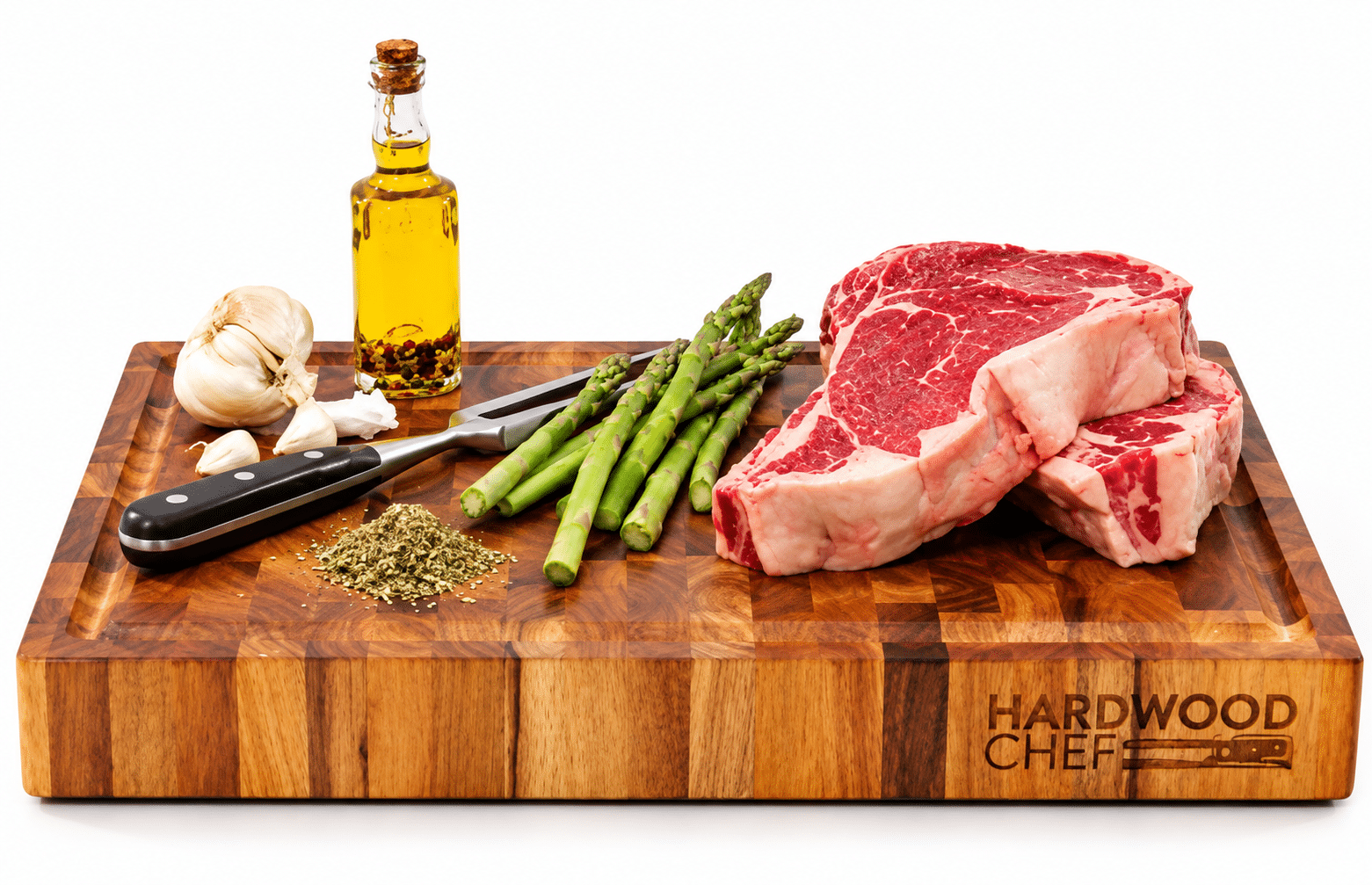
Researchers estimate plastic cutting boards can shed tens of millions of microplastic particles into food each year, and the knife grooves they build up are hard to fully clean. Our thick end grain acacia board has no plastic to shed, is gentle on your knives, and doubles as a serving board. See why it's worth switching.
See the board, now $119Regularly $179 · Arrives gift-wrapped in butcher paperNew, smooth boards tend to shed less because there’s little for a blade to catch on. As grooves build up, each cut meets more raised edges, and wear tends to speed up.
Heat adds stress too. Repeated hot dishwasher cycles, hot pans set down nearby, and food going straight from the stove onto the board all work on the plastic, and our rundown of other kitchen tools that shed shows the same heat-and-wear pattern elsewhere.
The Five-Minute Check
Grab your board and find good light. Score each check 0 if it looks fine, 1 if it shows some wear, and 2 if it’s plainly worn, then add the scores up at the end.
1. The Light Check
Hold the board at an angle to a window or a bright lamp. Look for a network of fine lines and a hazy, frosted patch where you chop most.
Light scoring across the surface is normal on a board that’s a year or two old. What you’re watching for is depth and density, grooves that look more like a canyon system than a few scattered scratches.
Score: 0 for light, scattered marks, 1 for a hazy chopping zone, 2 for dense, deep-looking grooves.
2. The Fingertip Check
Close your eyes and slowly run your fingertips across the main chopping zone. Then do the same along an edge that barely gets used.
Keep Reading
If this one is your kind of read:
→ 13 Non-Toxic Kitchen Upgrades That Cost Less Than You Think
A real texture difference between the two means material has worn away from the busy spot, beyond cosmetic scuffing.
Score: 0 if they feel similar, 1 for a slight difference, 2 if the chopping zone feels rough or ridged.
3. The Fingernail Check
Drag a fingernail across the chopping zone, against the direction you usually cut. Shallow marks your nail glides over are normal wear.
Grooves that catch your nail are deep enough to hold moisture and food residue below what a sponge reaches. They also tend to be where wear is moving fastest.
Score: 0 if your nail glides, 1 if it catches in a few spots, 2 if it catches across much of the zone.
4. The Color Check
White and light-colored boards often turn gray or yellowish in the most-used areas. That shift is mostly staining settling into scored plastic, and on some plastics it can also reflect the material itself aging.
While You're Here
15 Charcuterie Board Ideas That’ll Steal the Show at Your Next Party
A charcuterie board doesn't have to mean the same fan of salami and a wedge of brie every time. That's a fine...
A board that’s changed color in one zone but not the rest is wearing unevenly, with that zone taking the most abuse.
Score: 0 for even color, 1 for a mild cast in the chopping zone, 2 for an obvious discolored patch.
Quick Facts: there’s no official replacement schedule for plastic cutting boards. Food-safety advice generally ties replacement to condition, especially grooves deep enough to make cleaning hard, rather than to a date on the calendar.
5. The Post-Wash Check
Wash the board normally, dry it, and look again under good light. Food color or residue still sitting in the grooves after a proper wash means the scoring has gotten deep enough to trap things.
Beet, tomato, and herb residue are the easiest to spot. Wherever residue survives a wash, moisture tends to linger too.
Score: 0 if it comes clean, 1 for faint traces in a few grooves, 2 for visible residue across the chopping zone.
Reading Your Score
Add up the five checks for a total between 0 and 10.

Jonathan grew up in New Jersey until his family moved to Germany, where he spent his youth in old-world butcher shops and French markets and learned that the best meals happen around a shared table. HardwoodChef started with one idea: make the board at the center of those moments.
Unlike plastic, it has nothing to shed into your food. Unlike glass or bamboo, its end grain is easy on your knives. And at nearly two inches thick, it’s sturdy enough to carve on and good-looking enough to serve straight from the board.
“Food brings people together. I wanted to make something worthy of sitting in the middle of it.”
Read Jonathan’s story| Total | What it suggests | Reasonable next step |
|---|---|---|
| 0 to 3 | Normal wear | Keep using it and recheck every few months |
| 4 to 6 | Wear is building | Use the tips below to slow it down, and start thinking about a replacement |
| 7 to 10 | Heavily worn | Plan a replacement soon, and move the board to light duty until then |
How this score works: it’s an editorial checklist for organizing the five checks, not a lab measurement of how much a board sheds. Two boards with the same score can wear very differently depending on the plastic, the knife, and how they’re used.
Age alone isn’t a reliable guide, since use varies so much from kitchen to kitchen. A two-year-old board in a busy household can score higher than a five-year-old one that mostly sees bread.
If It’s Shedding: Your Options
Replacing the board is the most direct answer, but a few in-between moves are worth knowing about first.
Retire It to Light Duty
A worn board can still handle low-pressure jobs like slicing bread or halving a sandwich, while a newer surface takes the heavy chopping. It’s a reasonable bridge while you decide what’s next.
Flip It or Shift Zones
If the board is reversible, switching sides gives you a fresh surface. On a one-sided board, deliberately chopping in less-used areas spreads the wear and buys some time.
What Usually Isn’t Worth It
Some people sand plastic boards to smooth them out. It can soften shallow scoring, but it doesn’t fix deep grooves and it creates plastic dust of its own, which works against the whole point.
Dig Deeper
How to Choose the Right Wood Cutting Board for Your Kitchen
Walk down a cutting board aisle and it's a wall of options that all look roughly the same. They aren't, and the...
Scrubbing harder with abrasive pads or strong cleaners doesn’t help either. It can rough up the surface further without doing anything about the grooves.
Replacing It
If it’s time, the main question is what to replace it with. Wood wears too, but what comes off is wood fiber rather than plastic, and a well-kept hardwood board can last for many years.
Our guide to choosing a wood board covers construction, wood type, and size, and our wood, plastic, and bamboo comparison lays out how the materials stack up beyond the shedding question. Bamboo boards vary a lot, since they’re glued strips and some lean on resin-heavy composites.
From the HardwoodChef Shop: Our thick acacia end-grain boards are built for daily knife work, since end grain tends to let knife marks close back up instead of scarring deeply. With hand washing and a monthly oiling, they’re designed to be bought once and kept for years.
If You’re Not Ready to Switch Yet
Not everyone is ready to replace a board today, and that’s fine. A few habits tend to slow wear on any plastic board.
Readers Can't Stop Opening These
★ 19 Ways to Make Your Wood Cutting Board Last a Lifetime
★ 21 Holiday Charcuterie Board Themes for Every Occasion
★ 31 Everyday Items Leaking Microplastics in Your Home Right Now
Hand wash instead of using the dishwasher, or at least use the top rack and skip the heated dry. Keep the board away from hot pans and burners, and let hot food cool a bit before it goes on the board.
Keep knives sharp, since a dull blade needs more force and tends to dig deeper. Many cooks also keep a separate board for raw meat, which splits the heavy cleaning and the wear across two surfaces.
Where This Leaves You
A five-minute check tells you more than guessing from how long you’ve owned the board. If yours scores in the middle or upper range, it’s reasonable to start planning a replacement before it looks obviously bad.
If you only do a few things: run this check every few months, keep plastic boards away from dishwasher heat, and move a worn board to light duty while you decide what’s next.
For the bigger picture on plastic exposure in the kitchen, our look at what the research shows so far is a good next stop. And if warping, cracks, or lingering smells show up alongside the wear, our warning signs checklist covers the hygiene side.