How to Choose the Right Wood Cutting Board for Your Kitchen

Walk down a cutting board aisle and it’s a wall of options that all look roughly the same. They aren’t, and the differences show up every time you pick up a knife.
This guide walks through what to weigh, in roughly the order it matters: construction, wood, thickness, size, and the smaller details that separate a good board from a frustrating one. There isn’t a single right answer, since the best board depends on how you cook.
If you’re switching from plastic, our guide to telling whether a plastic board is shedding covers the case for retiring the old one.
Start With Three Questions
Before comparing woods and dimensions, it helps to answer three things. How often do you cook, how much prep happens at once, and how much do you care about your knives?
Someone who cooks a few nights a week and mostly slices bread and cheese has different needs from someone breaking down a chicken every Sunday. Most of the decisions below get easier once those answers are clear.
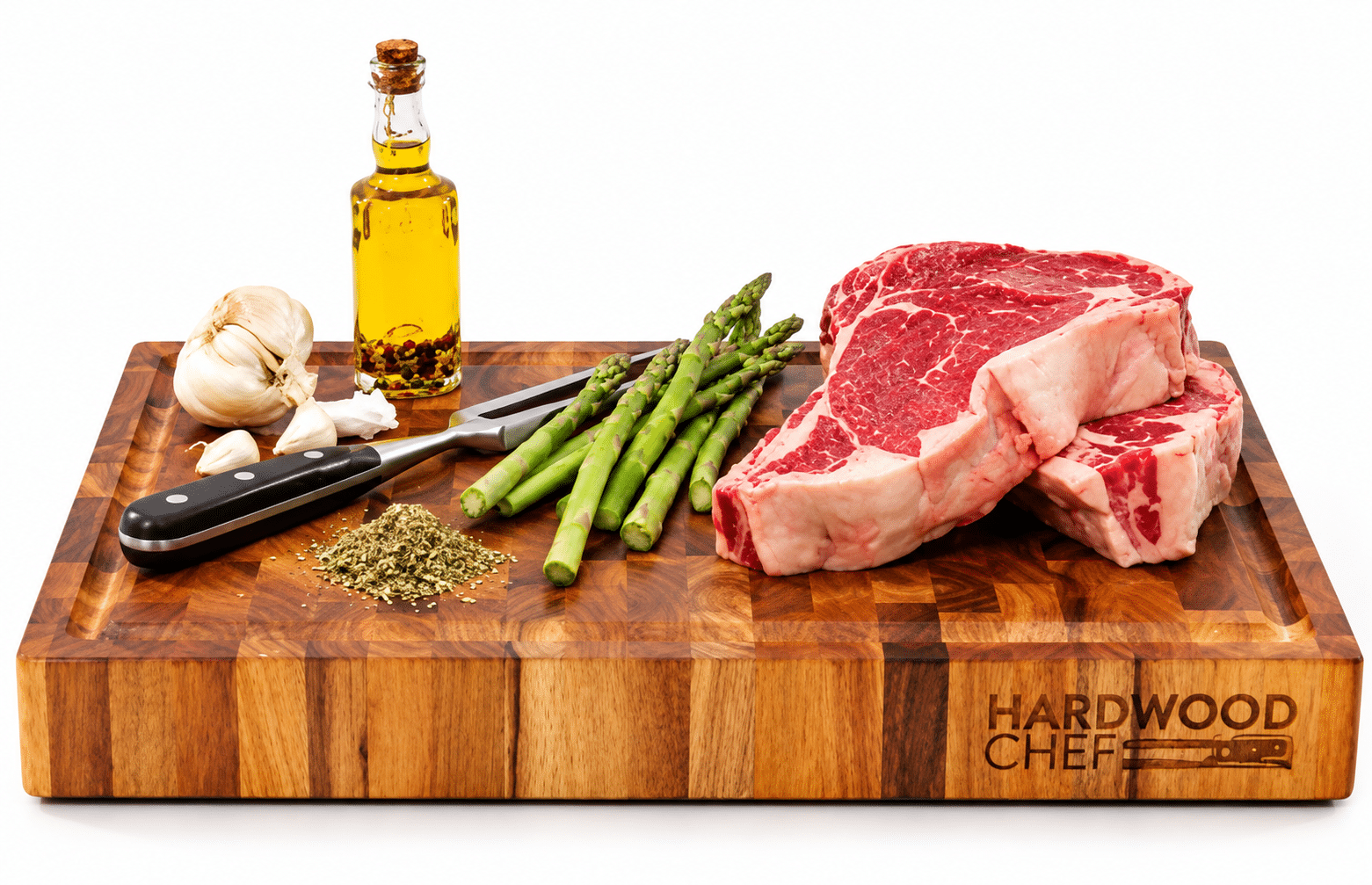
On end grain, your knife slips between the wood fibers instead of slicing across them, so it's easier on blades and the surface wears more slowly. Ours is 1¾ inches of solid acacia with a juice groove and finger grips, preconditioned with mineral oil and ready to use. See the details.
See the board, now $119Regularly $179 · Arrives gift-wrapped in butcher paperEdge-Grain vs. End-Grain (and Face-Grain)
Construction is the biggest single distinction, and it’s worth understanding before anything else.
Edge-Grain
Edge-grain boards are strips of wood glued side by side with the long grain facing up, which gives the classic striped look. They’re generally lighter and less expensive, and they handle everyday cooking well.
Because the knife cuts across the fibers, edge grain shows knife marks more over time and is a bit harder on blade edges than end grain. It also tends to need less oil, since the surface absorbs less.
End-Grain
End-grain boards are built so the wood fibers point straight up, creating a checkerboard of tiny columns. The blade slips between fibers instead of slicing across them, so end grain tends to be gentler on knives and lets minor cuts close back up.
The tradeoffs are weight, price, and a little more upkeep. Those exposed fibers soak up more oil and water, so end grain needs regular oiling and careful drying to stay stable.
Face-Grain
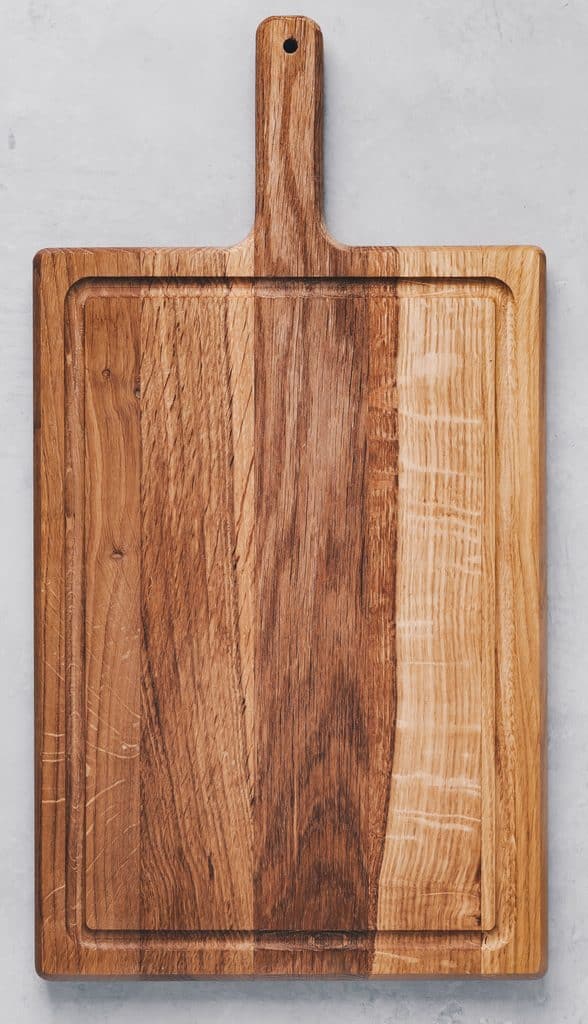
Face-grain boards show the wide, flat face of the wood, often as a single slab. They look beautiful and work well as serving boards, but wide single pieces tend to cup more easily and show cuts quickly, so they’re less common for heavy prep.
| Construction | Knife-friendliness | Upkeep | Rough price range | Often best for |
|---|---|---|---|---|
| Edge-grain | Good | Low to moderate | About $30 to $100 | Everyday cooking, lighter use |
| End-grain | Very good | Moderate | About $80 to $250+ | Frequent cooks and knife-focused cooks |
| Face-grain | Fair | Low to moderate | Varies widely | Serving, bread, light slicing |
About these ranges: prices are rough US retail estimates as of 2026 for mid-size hardwood boards, and they vary widely by size, wood, and maker. They’re meant for comparing construction types, not for setting a budget.
Keep Reading
If this one is your kind of read:
→ The Complete Wood Cutting Board Care Guide: Oiling, Cleaning & Storage
Simple rule of thumb: an occasional cook does fine with edge grain. A daily cook who keeps knives sharp tends to get the most out of end grain.
Wood Type
Not every wood suits a cutting board, and among the ones that do, there’s real variation in hardness, knife-friendliness, and looks. If you’re still weighing wood against other materials, our wood versus plastic versus bamboo comparison is worth reading first.
| Wood | Approx. Janka hardness | Knife-friendliness | Notes |
|---|---|---|---|
| Hard maple | Roughly 1,400 to 1,500 lbf | Good | The classic choice: dense, tight grain, light color |
| Walnut | Roughly 1,000 lbf | Very good | Softer and gentle on edges, shows wear a little sooner |
| Cherry | Roughly 950 lbf | Very good | Warm color that deepens with age |
| Acacia | Varies widely by species, roughly 1,100 to 2,300+ lbf | Good | Durable and naturally moisture-resistant, often well priced |
| Teak | Roughly 1,000 to 1,150 lbf | Fair | Natural oils resist moisture, but silica content can dull knives faster |
How to read this: Janka figures are approximate values from commonly published wood hardness references, and they vary by species, sample, and source. Higher numbers mean harder wood, which tends to resist dents but can be a little tougher on knife edges.
The sweet spot for most boards sits in the middle: hard enough to resist gouging, soft enough not to punish your knives. Maple, walnut, cherry, and acacia all land there.
Woods to Skip
Softwoods like pine and cedar dent and gouge easily and can carry resin flavors. Open-grain hardwoods, red oak in particular, have large pores that can hold moisture and food residue.
Some exotic species can cause skin irritation for some people, so a board made from an unfamiliar wood is worth looking into before buying. Bamboo is its own category, since it’s a grass laminated with adhesives, and quality varies a lot by product.
While You're Here
9 Salad Bowl Mistakes That Are Wilting Your Greens Faster
A salad that's crisp when you make it and sad twenty minutes later isn't always the greens' fault. A lot of it...
Thickness
Thicker boards resist warping better and last longer, since there’s more material before sanding and wear make a board unstable. They also stay put on the counter better.
A general guideline is around three-quarters of an inch to an inch for lighter use, and roughly 1.5 inches or more for a board that sees daily heavy chopping. End-grain boards usually sit on the thicker end, often around 1.5 to 2.5 inches.
Thinner boards are more prone to warping and don’t hold up as well to repeated restoration sanding. Our 19 ways to make a board last a lifetime covers how thickness and longevity connect.
Size, Matched to How You Cook
A board that’s too small sends food off the edges constantly. One that’s too big won’t fit your counter, your storage, or your sink.
| Kitchen and cooking style | Rough board size |
|---|---|
| Small kitchen, light prep, one or two people | About 10 by 14 to 12 by 16 inches |
| Regular cooking for a household | About 12 by 18 to 15 by 20 inches |
| Big-batch prep, carving, large families | About 18 by 24 inches or larger |
A note on sizing: these are common ranges rather than fixed standards. The right fit depends as much on your counter depth as on how much you cook.
Measure your sink and dish rack before buying a big board. A large, thick end-grain board can be heavy enough that carrying it to the sink is a two-hand job, and one that doesn’t fit anywhere for washing gets annoying fast.
Details Worth Checking
Small features change how a board works day to day. A few are worth looking for, and a couple are worth skipping.

Jonathan grew up in New Jersey until his family moved to Germany, where he spent his youth in old-world butcher shops and French markets and learned that the best meals happen around a shared table. HardwoodChef started with one idea: make the board at the center of those moments.
Unlike plastic, it has nothing to shed into your food. Unlike glass or bamboo, its end grain is easy on your knives. And at nearly two inches thick, it’s sturdy enough to carve on and good-looking enough to serve straight from the board.
“Food brings people together. I wanted to make something worthy of sitting in the middle of it.”
Read Jonathan’s storyJuice grooves catch liquid when you carve a roast or slice juicy fruit, but they shrink the flat working area. A reversible board with a groove on one side gives you both.
Handles and feet each have a tradeoff. Finger grips make a heavy board easier to lift, while rubber feet keep it from sliding but make it one-sided, so a damp towel or non-slip mat underneath is a more flexible option.
Finish matters more than people expect. A cutting surface should be finished with food-safe oil or an oil-and-wax blend, not lacquer, varnish, or another film finish that can chip under a knife.
Build quality shows up in tight, even glue lines with no gaps, a surface without rough patches, and a board that sits level instead of rocking. A well-made board should feel solid the moment you set it down.
One Board or Several
Plenty of kitchens do fine with one good board handling everything. Others benefit from a second, smaller board for quick jobs so the main one isn’t constantly in and out of the sink.
Many households also keep a separate board for raw meat, which limits cross-contamination and spares the nicer board the heavier cleaning. A serving board for cheese and bread is a nice third, though entirely optional.
Dig Deeper
The Beginner’s Guide to a Non-Toxic Kitchen, Room by Room
Most non-toxic kitchen advice throws forty things at you at once. This guide takes a different route. It goes zone by zone,...
If you’re only buying one, a mid-size end-grain board in a durable wood like maple or acacia covers the widest range of tasks. If you’re replacing a damaged board, our guide to replacing versus restoring can confirm it’s actually time.
Matching a Board to the Cook
Putting the pieces together, a few common profiles tend to point in clear directions.
The occasional cook usually does well with an edge-grain maple or acacia board around 12 by 16 inches and about an inch thick. It’s affordable, light, and easy to store.
The daily home cook tends to get the most from an end-grain board around 1.5 inches thick, sized for regular family prep. It’s kinder to knives and holds up to constant use.
The knife enthusiast often leans toward end-grain walnut, cherry, or maple, putting edge retention ahead of everything else.
Readers Can't Stop Opening These
★ Plastic-Free Kitchen Swaps: What to Replace First
★ 10 Toxic Kitchen Habits You Didn’t Know You Had
★ 15 Charcuterie Board Ideas That’ll Steal the Show at Your Next Party
The frequent entertainer may want a large, good-looking board that doubles as a serving piece, plus a smaller workhorse board for prep.
From the HardwoodChef Shop: Our thick acacia end-grain boards fit the daily-home-cook profile above: end-grain construction, a durable mid-hardness wood, and enough thickness to stay stable for years. The guidelines in this guide apply wherever you end up buying.
Putting It Together
For most home kitchens, a solid pick lands around end-grain construction, a durable mid-hardness wood like acacia or maple, about 1.5 inches thick, and a size that fits both your prep habits and your sink.
If you only weigh a few things: choose construction based on how often you cook, pick a wood from the middle of the hardness range, and measure your sink before you buy big.
Once you’ve picked one, our complete care guide covers how to keep it in good shape for years. And our list of common care mistakes is worth a quick read too, so a good purchase isn’t undone by a few bad habits.