12 Signs It’s Time to Replace (or Restore) Your Cutting Board

“Just replace it” is the default advice for pretty much any worn kitchen tool. For wood cutting boards specifically, that’s often the wrong first move.
A lot of damage that looks like the end is actually fixable with sandpaper and some oil. Some damage genuinely isn’t.
This is a decision framework, not a scare list. 12 signs, split into what’s fixable and what means it’s time to retire the board, counting down to the one sign that overrides everything else.
12. Surface Stains From Food
Verdict: fixable. Beet juice, turmeric, and berry stains sit in the top layer of wood fibers and don’t affect the board’s integrity.
A light sanding removes most surface staining if it bothers you. Otherwise it’s purely cosmetic and safe to ignore.
11. Light Knife Scoring
Verdict: fixable, often unnecessary to fix at all. Shallow surface marks from normal chopping are expected wear, not damage.
If they start bothering you visually, light sanding smooths them out. Functionally, they’re not a problem on their own.
10. A Slightly Dull, Dry-Looking Surface
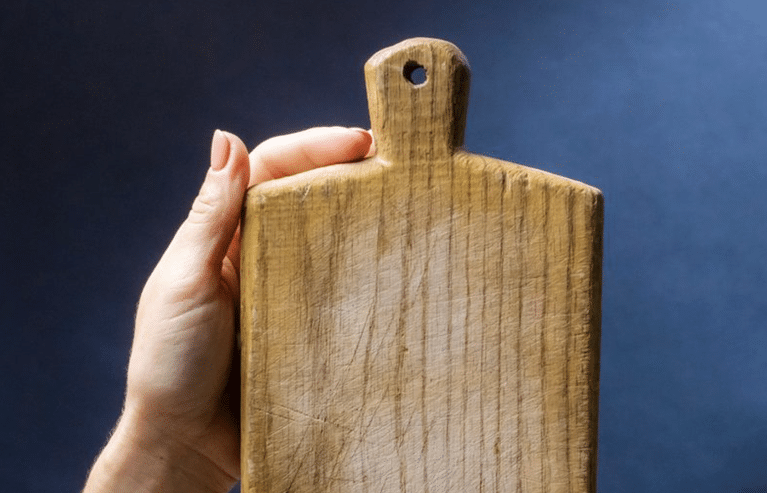
Verdict: fixable. This is usually just a board that’s overdue for oiling, not a structural issue.
A proper oiling, letting it soak in fully before wiping the excess, typically restores the look within a day or two.
9. Faded or Uneven Color
Verdict: fixable. Sun exposure and repeated washing can lighten or unevenly darken wood over time.
Sanding down to fresh wood and reoiling generally evens this out, and it’s more of an aesthetic fix than a functional necessity.
8. Deeper Grooves You Can Feel
Verdict: usually fixable. Grooves deep enough to catch a fingernail can trap food debris and moisture, but a moderate sanding, going below the groove depth, typically resolves it.
Once a board has been sanded down significantly over the years and is noticeably thinner than it started, that’s when this stops being a simple fix.
7. Loosening at a Glued Seam
Verdict: depends on severity. A slight gap at a seam on a multi-piece board can sometimes be reglued if caught early, though it’s a more involved fix than sanding.
If multiple seams are separating, or the board flexes noticeably at the joint, that’s typically past the point of a reasonable DIY fix.
6. A Board That’s Been Sanded Down Multiple Times
Verdict: nearing the end. Each sanding removes material, and a board that’s been through several rounds is thinner and structurally weaker than it started.
If it’s noticeably thinner than when new, or flexes slightly under pressure, it’s had a good run and is heading toward replacement rather than another restoration cycle. Repeated sanding is usually a sign of habits worth fixing too, our list of common care mistakes covers the usual culprits.
5. Persistent Smell That Doesn’t Go Away After Cleaning
Verdict: retire it. A smell that survives a proper wash and dry generally means something has worked its way deep into the wood, well past what sanding the surface can address.
This one’s not really a restoration candidate. It’s a sign to move on. Our 9 warning signs checklist covers this same smell test in more depth.
4. Soft or Spongy Spots
Verdict: retire it. A spot that gives under thumb pressure means water damage has already broken down the wood structure there.
Sanding the surface doesn’t fix internal breakdown. Once it’s soft, it’s generally considered done.
3. Visible Mold
Verdict: usually retire it. A very small, surface-level spot caught early on solid hardwood can sometimes be sanded away entirely. Anything beyond that, or mold that’s returned after a previous cleaning, means it’s established deeper than sanding reaches.
When in doubt on this one, err toward replacing rather than restoring. It’s not worth the risk.
2. A Crack That Runs Deep and Stays Open
Verdict: retire it. A crack with real depth to it, one that doesn’t close back up once the board dries, creates a permanent channel for moisture and bacteria that no amount of surface sanding resolves.
This is one of the clearer replace signals on this list. There’s not much ambiguity once a crack has real depth.
1. It Warps and Won’t Sit Flat
Verdict: retire it. This is the sign that overrides every other item on this list, because warping means the wood has absorbed moisture unevenly at a structural level, not just on the surface.
A warped board rocks on the counter, which is annoying on its own, but the bigger issue is that warping usually indicates deeper moisture retention that also makes the board more hospitable to bacteria.
Sanding can sometimes correct very mild warping, but significant warping, where the board rocks noticeably or won’t sit flat no matter how you position it, generally can’t be sanded flat without removing so much material the board becomes too thin to use safely.
If you’re at this point, it’s genuinely time to shop for a replacement rather than keep working around it. A dense, well-constructed end-grain board is less prone to this kind of warping in the first place, since the grain orientation handles moisture movement more evenly than edge-grain or single-slab construction.
The Bottom Line
Roughly the top half of this list is fixable with basic tools and a bit of time. The bottom half, smell, softness, mold, deep cracks, and warping, generally means it’s time to let the board go.
If you’re restoring, our complete care guide covers oiling technique in detail. If you’re replacing, our guide to choosing a new board walks through what actually matters this time around.